
5 Types of AI Agents: Complete Guide & Examples (2026)
5 Types of AI Agents: Complete Guide & Real-World Examples (2026)
Artificial intelligence is quietly powering many systems we interact with every day.
When a music app suggests your next playlist, when a website chatbot answers a question instantly, or when a delivery app calculates the fastest route — AI agents are doing the work behind the scenes.
These systems observe information, make decisions, and perform actions automatically.
But here's something many people don’t realize:
Not all AI agents work the same way.
Some follow simple rules, while others learn from experience and improve over time.
Understanding the types of AI agents in artificial intelligence can help businesses choose the right automation approach for their products, customer support, or internal workflows.
In this guide, we’ll explore:
- What an AI agent is
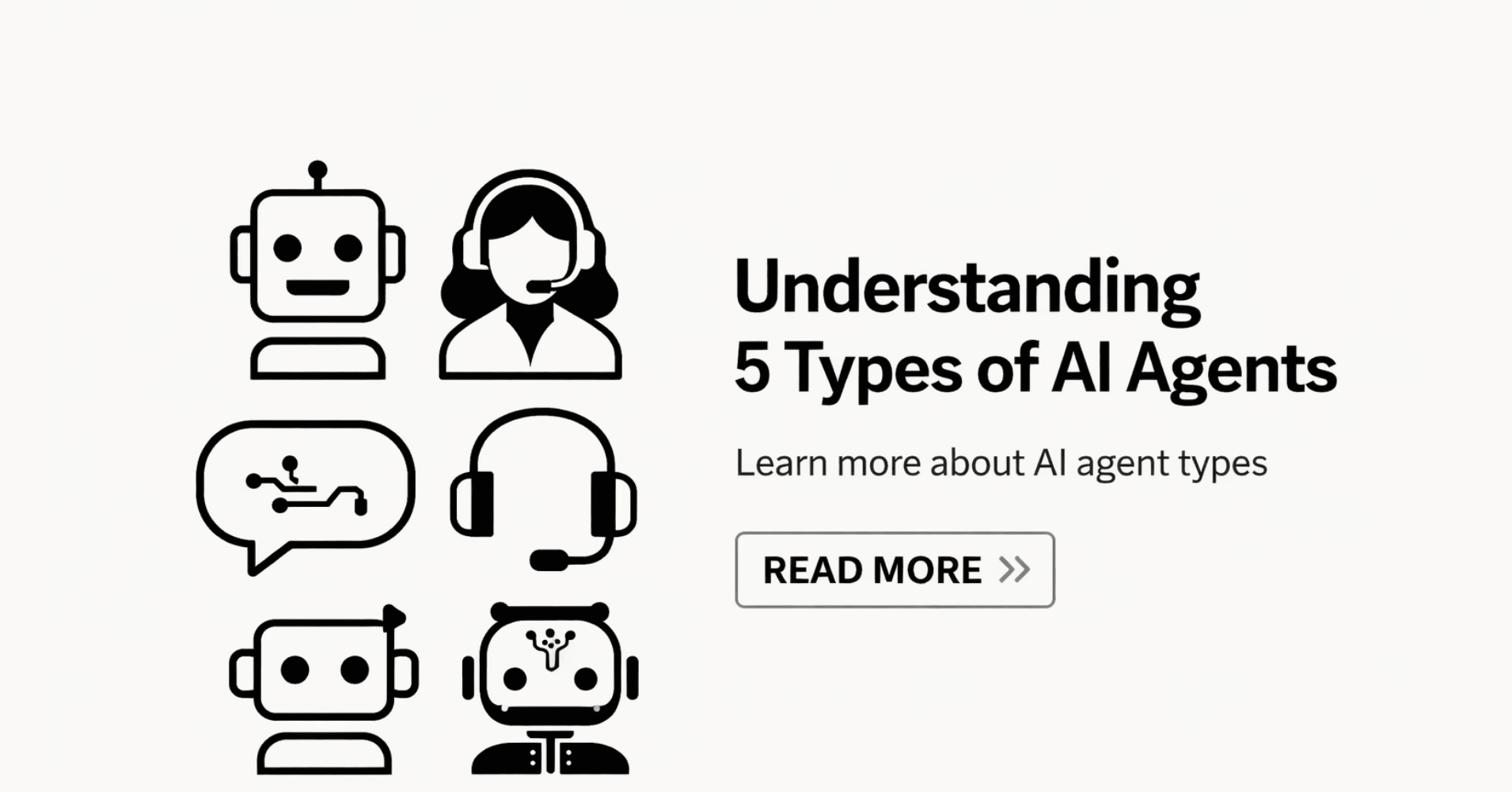
- The five major types of AI agents
- Examples of AI agents in real-world applications
- How businesses use them for automation
Let’s start with the basics.
What Is an AI Agent?
An AI agent is a software system designed to observe its environment, process information, and perform actions to achieve a specific outcome.
Unlike traditional programs that wait for instructions, AI agents can operate independently and respond to changes automatically.
Most intelligent agents share a few important characteristics:
1. Independence
AI agents can perform tasks without constant human involvement.
For example, an AI chatbot on a website can answer product questions without requiring a support agent to respond manually.
2. Responsiveness
Agents monitor events and respond when something changes.
A fraud detection system in a banking app may flag suspicious transactions immediately.
3. Goal-Driven Behavior
Many AI agents work toward a defined objective.
For instance, a logistics algorithm may attempt to minimize delivery time or transportation cost.
Because of these abilities, AI agents are widely used in automation, customer service, digital assistants, robotics, and data analysis.
The Five Types of AI Agents
AI agents are usually classified based on how they make decisions and how much information they use.
The five primary types include:
- Simple Reflex Agents
- Model-Based Reflex Agents
- Goal-Based Agents
- Utility-Based Agents
- Learning Agents
Each category represents a different level of intelligence and flexibility.
Let’s explore them individually.
1. Simple Reflex Agents
Simple reflex agents are the most straightforward type of AI agents.
They operate using predefined rules that connect conditions with actions.
In simple terms:
When a certain condition appears, the agent performs a specific action.
There is no memory involved, and the system does not learn from previous interactions.
How They Operate
These agents follow a pattern like:
If condition A occurs → perform action B
They react only to the current situation without considering past events.
Examples
-
Email spam filters (rule-based)
Basic spam filters scan incoming emails for certain keywords or patterns and move suspicious messages into a spam folder. -
Elevator control systems
Elevators respond when a button is pressed and move to the requested floor based on fixed operational rules. -
Automatic irrigation systems
Garden irrigation controllers turn sprinklers on or off depending on current soil moisture levels.
Advantages
- Very fast decision making
- Easy to design and implement
- Requires minimal computing resources
Limitations
- No learning capability
- Cannot handle unexpected situations
- Limited adaptability
Simple reflex agents work best in stable environments with predictable conditions.
2. Model-Based Reflex Agents
Model-based agents add an important capability missing in simple reflex systems: memory.
Instead of reacting only to current inputs, these agents maintain an internal representation of their environment.
This internal model helps them understand what may be happening even when information is incomplete.
How They Work
A model-based agent tracks:
- Previous states of the environment
- Effects of its past actions
- Changes occurring over time
Using this information, the agent can make better decisions.
Examples
-
Inventory monitoring systems
Retail systems track stock levels and predict when products will run out based on previous sales patterns. -
Smart traffic lights
Traffic control systems analyze vehicle flow and adjust signal timing dynamically. -
Drone navigation systems
Delivery drones maintain maps of buildings and obstacles to navigate safely even when sensors cannot see everything at once.
Advantages
- Works well with incomplete information
- Uses memory for better decisions
- Improves efficiency in dynamic environments
Challenges
- Requires more processing power
- Internal models must stay accurate
These agents are commonly used in robotics, monitoring systems, and navigation technology.
3. Goal-Based Agents
Goal-based agents take decision making further by focusing on achieving specific objectives.
Instead of simply reacting to events, they analyze possible actions and determine which one helps them reach their goal.
How They Work
A goal-based agent typically:
- Identifies a target outcome
- Considers different actions
- Predicts the result of each action
- Chooses the best path toward the goal
This process allows the agent to plan ahead instead of reacting instantly.
Examples
-
Delivery route planners
Courier companies use AI systems that calculate the most efficient route for drivers. -
AI scheduling assistants
Calendar assistants suggest meeting times that accommodate everyone’s availability. -
Strategy game AI
Game engines evaluate possible moves and choose actions that improve the probability of winning.
Advantages
- Flexible decision making
- Capable of planning multiple steps ahead
- Easily adaptable if goals change
Drawbacks
- Requires more computational resources
- Decision making may take longer
Goal-based agents are useful in planning, logistics, and intelligent digital assistants.
AI Agents in Business Automation
Businesses increasingly use AI agents to automate tasks like customer service, marketing workflows, and internal support systems.
However, building intelligent agents from scratch can be expensive and technically demanding.
If your primary goal is improving customer support, automating conversations, or deploying AI agents quickly, a specialized platform may deliver faster ROI than a full enterprise suite.
👉 Chatzy AI is one example — helping businesses build AI agents trained on their content, connect data instantly, and deploy automation in minutes.
Focused tools often outperform broad platforms when your use case is specific.
For example, companies can train an AI agent on product documentation, FAQs, or knowledge bases and instantly provide automated customer assistance through chat.
4. Utility-Based Agents
Utility-based agents go beyond simply achieving goals.
They analyze multiple possible outcomes and choose the one that provides the highest overall benefit.
In other words, they attempt to maximize a numerical score representing how desirable an outcome is.
How They Work
The agent assigns values to different outcomes and compares them.
The action with the highest value is selected.
Examples
-
Energy management systems
Smart grids decide how to distribute electricity efficiently by balancing demand, cost, and sustainability. -
Online advertising platforms
Ad systems choose which advertisement to display based on predicted user engagement. -
Supply chain optimization tools
These systems determine the best shipping method by evaluating cost, delivery speed, and reliability.
Advantages
- Optimizes decisions across multiple variables
- Handles uncertainty effectively
- Produces better outcomes in complex situations
Limitations
- Difficult to design accurate scoring systems
- Computationally intensive
Utility-based agents are common in financial systems, optimization algorithms, and recommendation platforms.
5. Learning Agents
Learning agents represent the most advanced category of AI agents.
These systems continuously improve their performance by analyzing experience and feedback.
Instead of relying entirely on rules, they adapt over time.
How They Work
A learning agent generally includes four elements:
- Learning component that improves knowledge
- Decision component that selects actions
- Evaluation system that measures outcomes
- Exploration mechanism that tests new strategies
This structure allows the agent to refine its behavior.
Examples
-
Product recommendation engines
E-commerce platforms analyze browsing and purchase patterns to recommend relevant products. -
Voice assistants
Virtual assistants improve their speech recognition accuracy by analyzing millions of user interactions. -
AI-powered support bots
Customer service chatbots learn which responses solve issues faster and refine their answers accordingly.
Advantages
- Continuous improvement
- Adaptation to new situations
- Ability to discover better solutions
Challenges
- Requires large datasets
- Needs strong computing infrastructure
- Must be monitored to prevent errors or bias
Learning agents power many of the most advanced AI applications today.
How to Choose the Right AI Agent
Selecting the right type of AI agent depends on the complexity of your problem.
Here is a simplified breakdown:
-
Simple reflex agents
Best for straightforward automation tasks. -
Model-based agents
Useful when systems must track changes over time. -
Goal-based agents
Ideal when planning or decision strategies are required. -
Utility-based agents
Helpful when balancing multiple priorities. -
Learning agents
Best for systems that need to evolve and improve continuously.
In many real-world applications, modern AI systems combine multiple agent types to achieve the best results.
Final Thoughts
AI agents are becoming a core component of modern digital infrastructure.
From recommendation systems and logistics platforms to AI chatbots and customer support automation, these intelligent systems are helping organizations operate more efficiently.
Understanding the different types of AI agents helps businesses design smarter solutions and select the right technologies.
And if your goal is launching an AI agent quickly for customer support or automation, platforms like Chatzy AI make it possible to build and deploy intelligent agents in minutes.