
A Complete Guide to the Claude Opus 4.8 API
A Complete Guide to the Claude Opus 4.8 API
Are you looking to build advanced AI systems using Claude Opus 4.8?
This guide is designed for developers, product teams, and enterprises who want to harness Anthropic’s most intelligent model to date—without guesswork.
Claude Opus 4.8 represents a meaningful step forward in AI capability. It combines deep reasoning, long-context understanding, and agentic intelligence into a single, production-ready API. Whether you are building autonomous agents, large-scale coding systems, or enterprise workflows, this guide will walk you through everything you need—from API access to best practices.
By the end, you’ll have a clear, time-tested foundation for building reliable, scalable applications with the Claude Opus 4.8 API.
What Is the Claude Opus 4.8 API?
The Claude Opus 4.8 API is Anthropic’s frontier developer platform for accessing its most powerful hybrid reasoning model. It provides direct programmatic access to Claude Opus 4.8, enabling developers to integrate advanced AI intelligence without building models from scratch.
With Claude Opus 4.8, you can:
- Build long-running AI agents with sustained reasoning
- Analyze massive documents using a 1M token context window
- Execute complex, multi-step coding and planning workflows
- Power enterprise-grade assistants with consistency and safety
- Balance intelligence, latency, and cost using hybrid reasoning controls
At its core, Claude Opus 4.8 follows a disciplined philosophy: intelligence guided by structure, predictability, and safety—principles that scale well in real-world systems.
Learn more about the model: https://www.anthropic.com/claude/opus
Meet the Claude Model Family
Claude Opus 4.8 (Frontier Model)
- Anthropic’s most intelligent model
- 200K context window
- Hybrid reasoning (fast responses or extended thinking)
- Best-in-class coding, agents, and enterprise workflows
- Designed for high-stakes, production-critical systems
Claude Opus 4.1
- Drop-in replacement for Opus 4
- Improved precision for real-world coding tasks
- Strong multi-step planning and reasoning
Claude Sonnet (3.5 / 3.7)
- Optimized for speed and cost-efficiency
- Excellent for real-time and edge deployments
Claude Haiku
- Lightweight and fast
- Ideal for simple automation and high-volume workloads
If performance, reliability, and depth matter most, Claude Opus 4.8 is the clear choice.
Availability and Pricing
Claude Opus 4.8 is available on:
- Claude Developer Platform
- Amazon Bedrock
- Google Cloud Vertex AI
- Microsoft Foundry
Pricing:
- $5 per million input tokens
- $25 per million output tokens
- Up to 90% savings with prompt caching
- 50% savings with batch processing
How to Get a Claude Opus 4.8 API Key
Before using the Claude Opus 4.8 API, you’ll need an API key from Anthropic.
- Visit Anthropic: https://www.anthropic.com
- Log in or create an account
- From your dashboard, click “Get API Keys”
- Click “+ Create Key”
- Give your key a name and confirm
- Copy your API key and store it securely
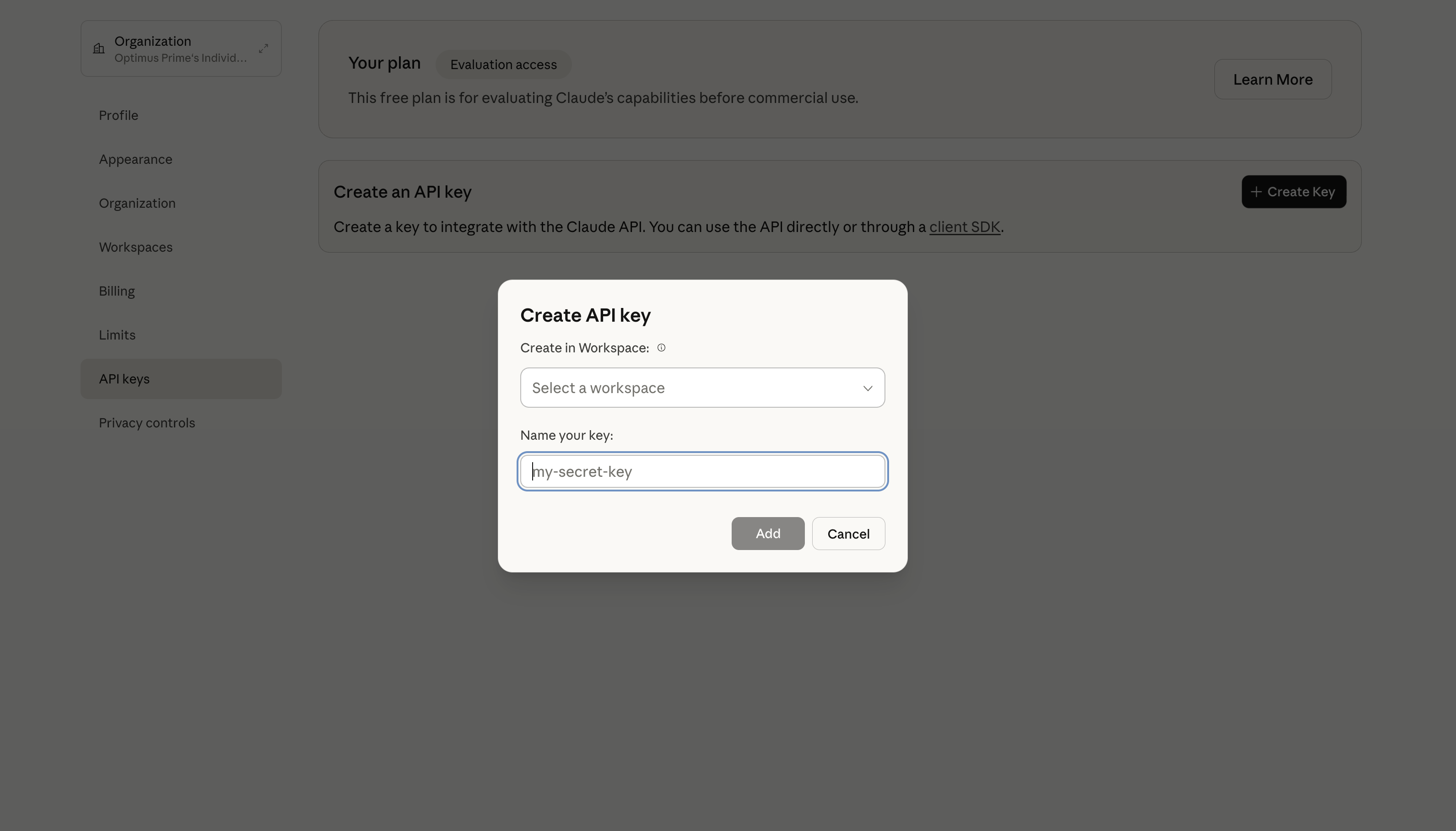
Best practice: Always use separate API keys for development, staging, and production environments.
Setting Up Your Development Environment
The Claude Opus 4.8 API works with any language capable of making HTTP requests. Python remains a dependable choice for clarity and speed.
Install the Anthropic SDK
pip install anthropic
Initialize client
import anthropic

client = anthropic.Anthropic(
    api_key="YOUR_API_KEY"
)
This explicit setup mirrors Anthropic’s design philosophy: minimal complexity, maximum control.
Testing Your Claude Opus 4.8 API Connection
Before building larger systems, test your connection with a simple request.
response = client.messages.create(
    model="claude-opus-4-7",
    messages=[
        {"role": "user", "content": "Hello, Claude Opus 4.8"}
    ]
)

print(response)
A successful response confirms your environment is ready.
Messages API vs Text Completions API
Anthropic supports two interaction styles, but only one is future-proof.
Messages API (Recommended)
- Multi-turn conversations
- Tool usage and agent workflows
- System prompts and structured reasoning
- Long-context support
Text Completions API (Legacy)
- Basic text generation
- Limited flexibility
- Not suitable for modern AI agents
Recommendation: Use the Messages API exclusively for Claude Opus 4.8 integrations.
Core Capabilities of the Claude Opus 4.8 API
Hybrid Reasoning
Choose between instant responses or deeper reasoning, balancing performance, latency, and cost.
Massive Context Window
- Up to 200K tokens
- Analyze large codebases, documents, and datasets
- Ideal for enterprise knowledge systems
System Prompts
Control tone, role, and behavior consistently.
response = client.messages.create(
    model="claude-opus-4-7",
    system="You are a senior software architect who values clarity and maintainability.",
    messages=[{"role":"user","content":"Design a scalable API architecture."}]
)
Stop Sequences
Define clear stopping points to keep outputs predictable.
Tool Use & AI Agents
Claude Opus 4.8 excels at agentic workflows—reasoning about when and how to use tools for complex tasks.
Best Practices
- Write clear, structured prompts
- Use system prompts deliberately
- Control reasoning depth for cost management
- Choose stable models for production
- Implement retries and error handling
- Cache frequent responses
- Prefer server-side API calls
- Rotate and restrict API keys
- Monitor usage consistently
These practices reflect engineering discipline that scales over time.
Claude Opus 4.8 vs ChatGPT vs Gemini
| Model | Strengths | Best For |
|---|---|---|
| Claude Opus 4.8 | Deep reasoning, safety, long context, agent workflows | Enterprise systems, coding agents, high-stakes tasks |
| ChatGPT API (OpenAI) | Versatility, multimodal support, large ecosystem | Conversational apps, content generation, rapid prototyping |
| Gemini API (Google AI) | Multimodality, native tools, Google ecosystem integration | Search-driven and multimodal applications |
Summary: Choose Claude Opus 4.8 when reliability, reasoning depth, and enterprise-grade behavior matter most.
App Ideas to Build with the Claude Opus 4.8 API
- Autonomous software engineering agents
- Enterprise knowledge assistants
- Long-document analysis systems
- AI-powered code review and refactoring tools
- Research and planning agents
- Multi-step business workflow automation
- Compliance and policy analysis tools
Build AI Agents on Chatzy AI Using Your Own API Keys
Beyond building from scratch, you can also deploy Claude-powered experiences quickly using Chatzy AI.
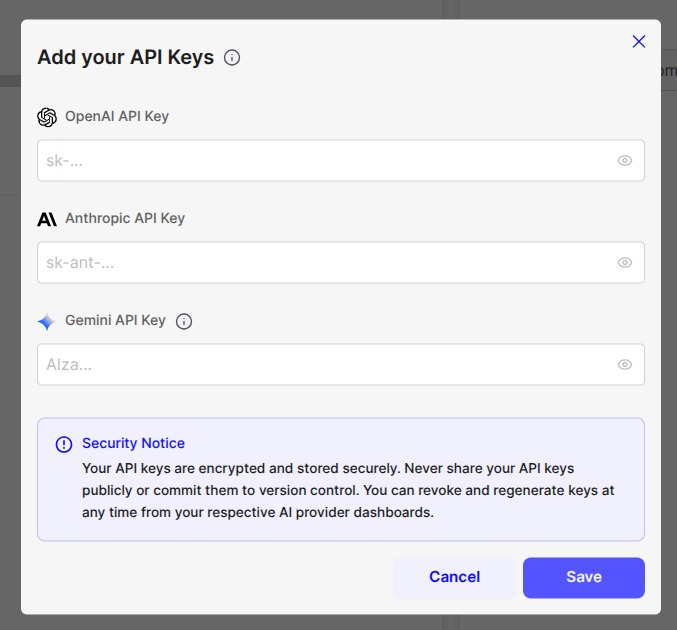
Chatzy AI allows you to create custom AI agents and connect your own Claude Opus 4.8 API key, giving you full control over cost, behavior, and data flow—without infrastructure overhead.
What You Can Do with Chatzy AI
- Create AI agents without writing backend code
- Plug in your own API keys instantly
- Use Gemini and Anthropic (Claude) APIs with the same setup
- Switch models without rebuilding your agent
- Retain full ownership of usage, billing, and limits
This approach is ideal for teams who value transparency, flexibility, and proven architectural discipline.
Start Building with the Claude Opus 4.8 API
The Claude Opus 4.8 API offers a dependable path from experimentation to production—backed by Anthropic’s commitment to safety, rigor, and real-world reliability.
Start small, build deliberately, and scale with confidence. Claude Opus 4.8 is designed not just to impress—but to last.